
A food processor is a versatile kitchen appliance designed to make food preparation easier and quicker. Typically, it features a motorized base, a clear work bowl with a lid and feed chute, and various interchangeable blades and discs. These components work together to chop, slice, shred, grate, and puree ingredients efficiently, saving you time and effort in the kitchen. Understanding its appearance helps you identify different types and functions, ensuring you pick the right tool for your cooking needs.
What Does Food Processor Look Like
Have you ever wondered what exactly a food processor is, or what it looks like when you see one in a store or a friend’s kitchen? It’s a common question! This essential kitchen appliance is a true workhorse, designed to make your food preparation tasks much quicker and easier. But before you can unlock its culinary superpowers, it helps to know what you’re looking at.
In this comprehensive guide, we’re going to take a close look at the anatomy of a food processor. We’ll explore its core components, discuss the different sizes and styles you might encounter, delve into the materials used, and give you practical tips for identifying one. By the end, you’ll be able to confidently spot a food processor, understand its various parts, and even have a better idea of what to look for if you’re considering adding one to your kitchen arsenal. Let’s get started!
Key Takeaways
- Main Components: A standard food processor consists of a heavy motor base, a transparent work bowl with a lid and feed chute, and a range of interchangeable blades and discs.
- Size Variations: Food processors come in various sizes, from compact mini choppers (1-5 cups) perfect for small tasks to full-sized models (9-14+ cups) capable of handling large batches and more complex prep.
- Blade Versatility: The iconic S-blade is for chopping and pureeing, while specialized disc blades allow for precise slicing, shredding, and grating of different foods.
- Safety Features: Most food processors include interlocking safety mechanisms that prevent the machine from operating unless all parts (bowl, lid) are correctly assembled and locked into place.
- Aesthetics & Materials: While functionality is key, food processors also vary in design, color, and materials (plastic, stainless steel), influencing durability and kitchen aesthetic.
- Identifiable Features: Look for a stable base, a clear processing bowl, a secure lid with a feed chute for adding ingredients, and easily attachable blades and discs.
- Beyond the Basics: Some models offer additional features like built-in scales, multiple work bowls, or combo functions with blenders, expanding their utility and visual complexity.
The Core Components of a Standard Food Processor
Think of a food processor as a collection of specialized parts that work together in harmony. While designs can vary slightly between brands and models, the fundamental structure remains largely the same. Here are the key elements you’ll typically find:
The Base Unit (Motor Housing)
This is the heart of your food processor. The base unit is generally the heaviest part of the appliance because it houses the powerful motor. This motor is what drives the blades and discs, doing all the hard work for you.
- Appearance: It’s usually a sturdy block, often rectangular or rounded, designed to sit firmly on your countertop. You’ll find control buttons or dials on its front or side, allowing you to select speeds (like “on,” “off,” “pulse,” or variable speeds). The power cord usually extends from the back of this unit, sometimes with a storage compartment to tuck it away neatly.
- Function: The base provides essential stability during operation, preventing the machine from “walking” across your counter, especially when processing tough ingredients. It also contains all the electronic controls necessary to operate the food processor safely and efficiently.
The Work Bowl
The work bowl is where all the magic happens – where your ingredients are processed. It’s the central container that holds everything you want to chop, slice, or shred.
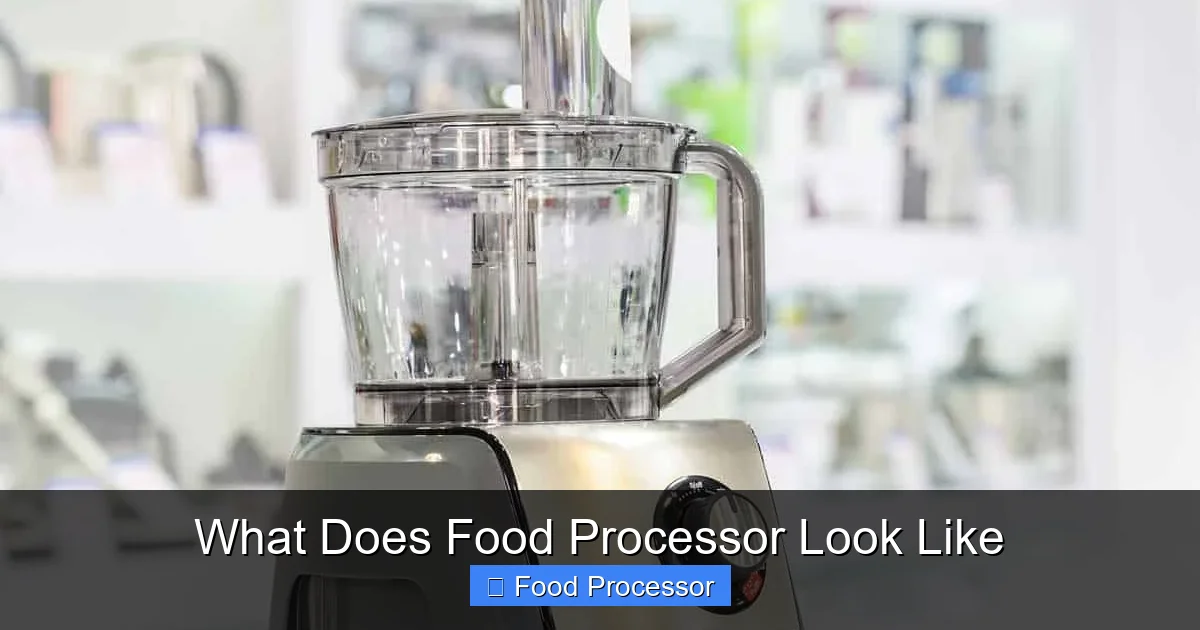
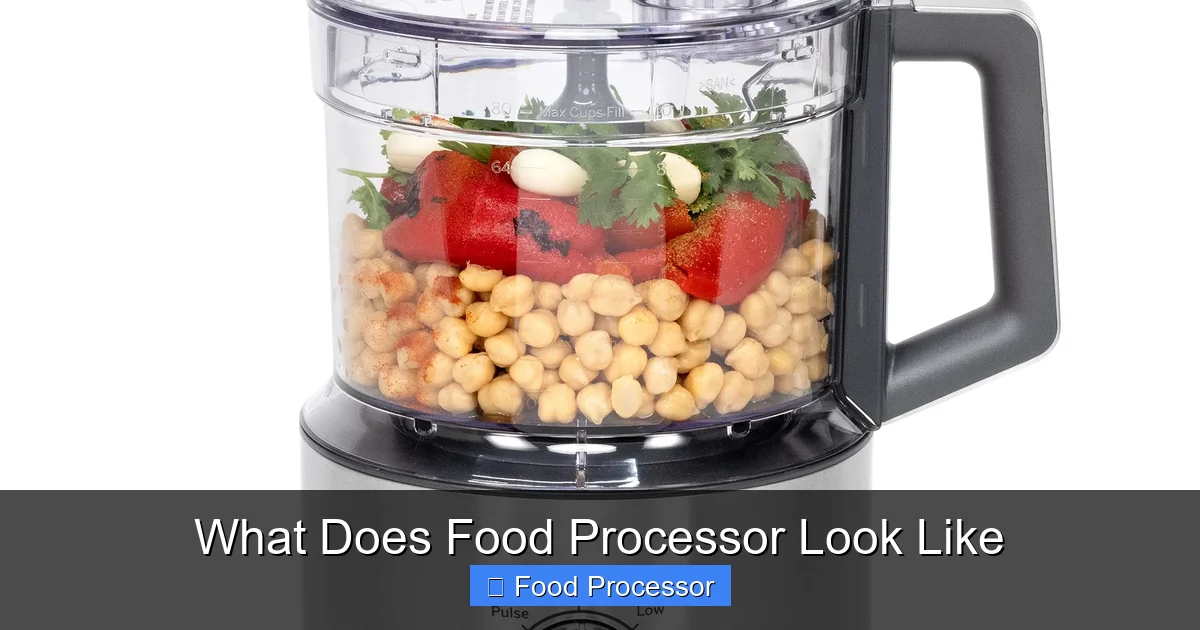
- Appearance: It’s typically made from clear, durable plastic (like polycarbonate), allowing you to see your food as it’s being chopped, sliced, or shredded. Work bowls come in various capacities, from small (1-5 cups) to large (9-14+ cups). It will have a handle on one side for easy lifting, pouring, and securing it onto the base. Some models even include multiple work bowls of different sizes to handle various batch quantities.
- Function: It securely attaches to the motor base, usually with a twisting or clicking motion, forming a sealed unit. This bowl is designed to contain food safely and effectively while the blades or discs are spinning at high speeds.
The Lid with Feed Chute
No food processor is complete without its lid! This isn’t just any lid; it’s a crucial safety and functionality component that truly defines the food processor’s look.
- Appearance: Like the work bowl, the lid is usually made of clear, durable plastic, allowing for visibility. It features a specific opening called a “feed chute” (sometimes pronounced “shoot”), which is a tube built into the lid. This chute is the gateway for adding ingredients. You might see a larger, wider chute for items like potatoes or smaller, more specialized chutes for slender vegetables.
- Function: The lid locks onto the work bowl, often with a safety mechanism that prevents the food processor from operating unless it’s properly secured. This is a vital safety feature to protect your hands from the spinning blades. The feed chute allows you to steadily add ingredients like vegetables for slicing, liquids for emulsifying, or herbs for chopping without having to stop the machine, making continuous processing possible.
The Pusher (Food Pusher)
This small but mighty accessory works hand-in-hand with the feed chute. It’s an indispensable part of the food processor system.
- Appearance: It’s a cylindrical or tapered plastic piece designed to fit snugly inside the feed chute. Some pushers are quite simple, while others are more elaborate, possibly having a smaller inner tube that doubles as a measuring cup or allows for trickier, smaller ingredients to be added more precisely.
- Function: You use the pusher to gently guide food down the feed chute towards the spinning blades or discs. It keeps your fingers safely away from the sharp parts while ensuring even processing and preventing food from getting stuck in the chute.
The S-Blade (Chopping Blade)
This is often the most recognizable blade and is usually included with every food processor. It’s the workhorse for many common kitchen tasks.
- Appearance: It’s a metal blade, typically stainless steel, shaped like an “S” or a slightly bent propeller. It has two sharp ends that are positioned at different heights and a central hub that fits onto the drive shaft within the work bowl. The blades are exceptionally sharp, designed to cut through various food textures efficiently.
- Function: The S-blade is your go-to for chopping nuts, mincing garlic, pureeing soups, making breadcrumbs, mixing doughs, and general chopping tasks. It’s incredibly versatile and responsible for much of the basic “food processing” a machine does.
Disc Blades (Slicing/Shredding)
Beyond the S-blade, food processors typically come with a variety of flat, round discs that expand their functionality.
- Appearance: These are usually made of durable stainless steel and are flat and circular. They feature different types of perforations or raised edges. You’ll commonly find a slicing disc (with a single long, sharp slit) and a shredding/grating disc (with many small, sharp holes). Some are cleverly designed to be reversible, offering two functions on one disc (e.g., coarse shred on one side, fine shred on the other).
- Function: These discs sit at the top of the work bowl, just beneath the lid, mounted on a disc stem or adapter. When food is pushed down the feed chute, it makes contact with the spinning disc and is precisely sliced or shredded into the bowl below. They are perfect for preparing salads, coleslaws, or grating cheese quickly.
Exploring Different Sizes and Styles
Visual guide about What Does Food Processor Look Like
Image source: kitchenseer.com
Just like cars, food processors aren’t one-size-fits-all. They come in various capacities and designs, each suited for different kitchen needs. If you’re considering how to choose the right size food processor, understanding their appearance is key.
Full-Size Food Processors (9 cups and up)
- Appearance: These are the workhorses of the kitchen. They typically have a large, substantial motor base and a work bowl capacity ranging from 9 to 14 cups, or even larger for professional models. They often come with a more extensive set of accessories and a wider, taller feed chute to accommodate larger produce like whole potatoes or blocks of cheese. Their overall footprint is significant.
- Ideal for: Large families, frequent entertainers, or anyone who preps big batches of food, makes dough, or needs to process larger quantities of vegetables. Their larger size means they take up more counter or cabinet space, so consider your storage before purchasing.
Compact/Mini Food Processors (1-5 cups)
- Appearance: These smaller versions are characterized by their compact motor base and a smaller work bowl, usually between 1 to 5 cups. They often have simpler controls, sometimes just a single “pulse” button. They might have a narrower feed chute, reflecting their smaller scale. Their lighter weight and smaller size make them less imposing on the countertop.
- Ideal for: Single individuals, couples, small kitchens with limited space, or for processing smaller quantities of ingredients like garlic, herbs, nuts, or making dressings. They are lighter, easier to handle, and simpler to store than their full-sized counterparts.
Specialty Food Processors and Combos
Some food processors boast unique designs or integrate multiple functions, offering a different visual and functional experience.
- Appearance: High-end models often feature sleek stainless steel finishes, more robust build quality, and possibly digital displays instead of simple buttons. You might see models with multiple work bowls of different sizes that nest together for convenience, suggesting greater versatility.
- Food Processor/Blender Combos: These appliances combine the functions of both a food processor and a blender into one base unit. They might have interchangeable attachments – a traditional food processor bowl and a tall blender pitcher – that mount onto the same motor base. The base for these is usually quite sturdy and might have more specialized controls to switch between functions. If you’re looking for a versatile kitchen tool that saves counter space, exploring what is the best food processor and blender combo might be a good idea.
Materials and Aesthetics
Visual guide about What Does Food Processor Look Like
Image source: m.media-amazon.com
Beyond just function, how a food processor looks and the materials it’s made from contribute to its overall appeal, durability, and how it fits into your kitchen’s style.
Housing Materials
- Plastic: This is the most common material for the motor base, especially for entry-level and mid-range models. It’s lightweight, comes in various colors, and is cost-effective. High-quality plastics should be BPA-free and durable.
- Stainless Steel: Often found on higher-end or more professional-looking models. It offers a sleek, modern aesthetic that complements many contemporary kitchens and is generally more durable and easier to clean. Stainless steel models tend to be heavier, adding to their stability.
- Die-cast Metal: Very heavy-duty and robust, providing excellent stability and durability. Usually seen in premium or commercial-grade food processors, these models exude a sense of industrial strength and longevity.
Bowl and Lid Materials
Almost universally, these parts are made from clear, impact-resistant plastic, such as polycarbonate. This transparency is crucial as it allows you to monitor the processing progress without constantly removing the lid, which is both convenient and a key safety feature. High-quality plastic will resist scratching, staining, and clouding over time, maintaining its clear appearance.
Blade Materials
The S-blade and all disc blades are nearly always made from high-quality stainless steel. This material is chosen for its exceptional sharpness, corrosion resistance, and long-lasting durability. The drive shafts that connect the blades to the motor are also typically made of metal for maximum strength and efficient power transfer.
Color and Design
Food processors come in a spectrum of colors, from classic black, white, and silver to bolder reds, blues, or even pastels, allowing you to match them to your kitchen décor. The design can range from minimalist and modern, with smooth lines and hidden controls, to more industrial and robust. Some brands have distinctive design philosophies, making their food processors instantly recognizable.
What to Look for When Inspecting a Food Processor
Whether you’re unboxing a new food processor or checking out a used model, knowing what to look for visually can tell you a lot about its quality and condition. This is a crucial step when you are considering what to look for when buying a food processor, as visual cues often indicate underlying quality.
Sturdiness and Stability
The base unit should feel heavy and solid. This indicates a good motor and robust build quality, which translates to less vibration, noise, and improved longevity during operation. A food processor that feels light or flimsy is a red flag.
Clear Markings and Controls
The control panel should be easy to understand, with clearly labeled buttons or a legible dial. Look for distinct “on,” “off,” and “pulse” settings. Digital displays, when present, should be bright and easy to read. Worn-off labels or stiff buttons can indicate heavy use or poor quality.
Secure Locking Mechanisms
Test how the work bowl attaches to the base and how the lid locks onto the bowl. It should feel secure, with a satisfying click or snap, and without any wiggling. Any looseness could indicate a faulty safety mechanism or general wear and tear, which is a significant concern.
Condition of Blades and Bowl
Examine the S-blade and disc blades for sharpness and any signs of rust, bending, or excessive wear. Dull or damaged blades will not process food effectively. The work bowl and lid should be free of cracks, deep scratches, or significant discoloration, which can weaken the plastic over time and potentially harbor bacteria.
Cord Length and Storage
While often overlooked, a good cord length that reaches your outlets comfortably is important. Additionally, check for a cord storage compartment (where the cord can be wrapped and tucked away) in the base unit. This small visual feature contributes significantly to kitchen tidiness and convenience.
Understanding Food Processor Variations and Combos
While we’ve covered the standard food processor, it’s worth noting some variations you might encounter in the marketplace.
Blender/Food Processor Combos
As mentioned earlier, these units offer a single base that can accommodate both a food processor bowl and a blender pitcher. Visually, the base might be a bit larger or have a more robust feel to support both functions, often with a more sophisticated control panel. The attachments themselves will be distinctly different – the wide, short food processor bowl versus the tall, narrow blender pitcher. This versatility is one of the many advantages of a food processor system, offering more bang for your buck and potentially reducing countertop clutter.
Handheld Food Choppers (Mini Choppers)
While technically small food processors, these often look quite different from their full-sized counterparts. They are typically much smaller, sometimes with a single button on top that you press to activate the blade. The bowl is usually tiny (1-3 cups), and they have very few, if any, interchangeable parts beyond the S-blade. They’re great for quick, small tasks like chopping a single onion or a handful of herbs but don’t offer the extensive versatility of a full-sized food processor. Their design emphasizes portability and simplicity.
Commercial Food Processors
If you ever peek into a professional kitchen, you’ll see food processors that look significantly more robust and industrial. They are larger, often made entirely of heavy-gauge stainless steel, and designed for continuous, heavy-duty use. Their feed chutes can be massive, and they might have multiple dedicated motors or more complex safety interlocks. These are built for endurance and high volume, looking less like a home appliance and more like machinery engineered for demanding culinary environments.
Practical Tips for Identifying and Choosing Your Food Processor
Now that you know what a food processor looks like, here are some final tips to help you in your kitchen journey:
- Match Size to Needs: A small family won’t need a 14-cup behemoth, just as a large family will struggle with a 3-cup mini chopper. Visually compare the bowl sizes to your typical batch sizes.
- Assess Accessories: Beyond the basic S-blade, check what other discs (slicing, shredding, grating) are included. Some come with a dough blade or emulsifying disc, which can be a visual cue of its expanded capabilities for specific recipes.
- Consider Storage: Food processors, especially full-sized ones, can take up significant counter or cabinet space. Visually estimate where it will live in your kitchen and if its components can be neatly stored.
- Read Reviews: While appearance is important, reading reviews will tell you if the design is also functional and durable in practice, and how well it performs its intended tasks.
Conclusion
A food processor is more than just a kitchen gadget; it’s an investment in efficiency and culinary convenience. By understanding “what does food processor look like,” you’ve gained the knowledge to identify its key components – from the sturdy motor base to the versatile S-blade and various discs. You can now recognize the differences between compact and full-sized models, appreciate the materials used in their construction, and even spot the tell-tale signs of quality.
Whether you’re a seasoned chef or a budding home cook, knowing the anatomy of this appliance empowers you to make informed decisions, utilize it effectively, and appreciate the thoughtful engineering that goes into making your kitchen tasks a breeze. So, next time you see a food processor, you won’t just see an appliance; you’ll see a powerhouse ready to chop, slice, and puree its way to delicious meals!
