

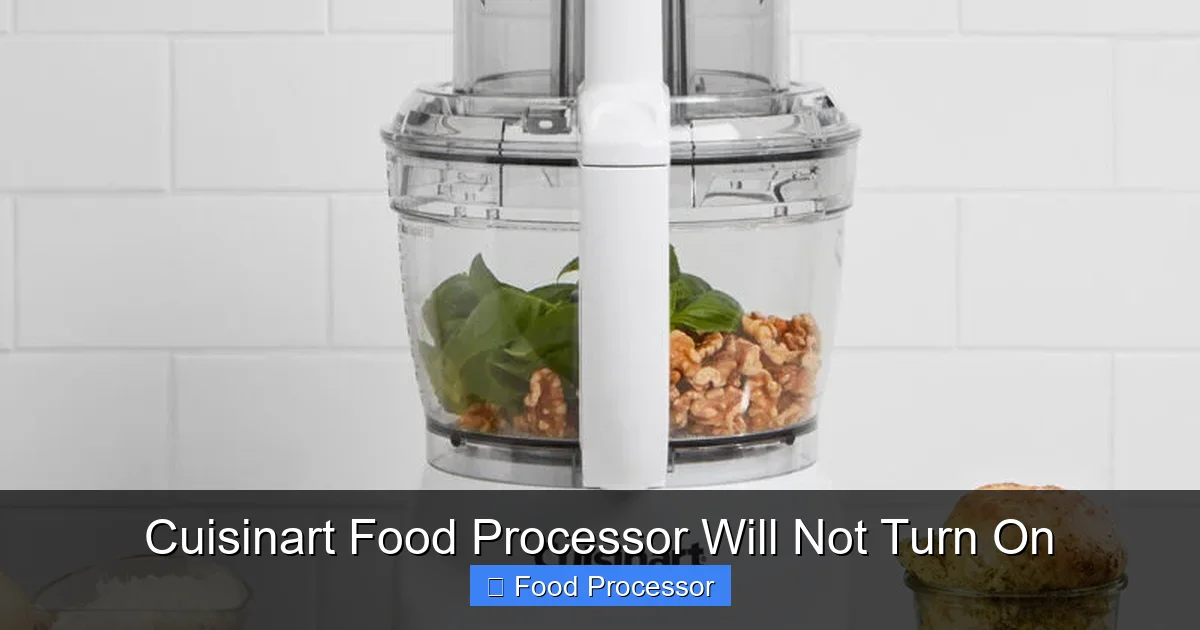
When your Cuisinart food processor will not turn on, it’s usually due to common issues like improper assembly, power supply problems, or activated safety features. This comprehensive guide walks you through easy troubleshooting steps to diagnose and resolve why your Cuisinart food processor isn’t working, helping you get back to blending and chopping in no time. Learn to check power, reassemble correctly, and reset safety mechanisms.
Cuisinart Food Processor Will Not Turn On
There’s nothing quite as frustrating as being ready to whip up a delicious meal, only to find your trusty Cuisinart food processor will not turn on. One moment you’re dreaming of perfectly chopped vegetables or silky smooth hummus, and the next, silence. Don’t worry, you’re not alone! This is a common issue that many Cuisinart owners encounter, and more often than not, it’s a simple fix.
Cuisinart food processors are renowned for their durability and performance, but they also come equipped with sophisticated safety mechanisms. These features are designed to protect you from injury and prolong the life of your appliance. However, they can also be the very reason why your Cuisinart food processor might not be working when you expect it to. In this comprehensive guide, we’ll walk you through every possible reason why your Cuisinart food processor will not turn on and provide clear, step-by-step instructions on how to troubleshoot and fix the problem. By the end, you’ll be well-equipped to get your appliance back in action and cooking up a storm.
Key Takeaways
- Safety First: Always unplug your Cuisinart food processor before checking any components or attempting fixes to prevent electrical hazards.
- Proper Assembly is Key: Most Cuisinart food processors have an intricate safety interlock system. Ensure the bowl, lid, and pusher are perfectly aligned and locked into place for the unit to power on.
- Check the Power Source: Verify that the outlet is working, the power cord is undamaged, and the circuit breaker hasn’t tripped. A simple power issue can often be the culprit.
- Overload Protection: If the motor was overworked, it might have tripped its internal thermal fuse. Unplug the unit, let it cool down, and then try plugging it back in and restarting.
- Examine Blades and Accessories: Ensure the blade is properly seated and nothing is jamming the motor shaft or preventing the blade from rotating freely.
- Listen and Look for Clues: Pay attention to any sounds (or lack thereof), smells (like burning), or visible damage. These can provide vital clues about the underlying problem.
- Professional Help: If basic troubleshooting fails and you suspect an internal electrical or motor fault, it’s best to contact Cuisinart customer service or a qualified appliance repair technician.
Step 1: Prioritize Safety – Unplug Your Cuisinart Food Processor
Before you begin any troubleshooting, the absolute first and most important step is to ensure your safety. Dealing with electrical appliances requires caution.
Unplug from the Wall Outlet
Reach behind your Cuisinart food processor and firmly pull the plug straight out of the wall socket. Do not simply turn off the power button on the unit itself. This ensures that no electrical current is flowing to the appliance, making it safe for you to inspect and manipulate its parts.
Why This Is Crucial
Touching internal components or even simply repositioning parts while the unit is still plugged in can pose a risk of electric shock or accidental activation. Always start with a completely de-energized appliance.
Step 2: Check the Power Supply
It might seem obvious, but often the simplest solution is the correct one. A lack of power is a common reason why your Cuisinart food processor will not turn on.
Visual guide about Cuisinart Food Processor Will Not Turn On
Image source: howdykitchen.com
Verify the Outlet is Working
Sometimes, the outlet itself is the problem.
- Test with another appliance: Plug another small appliance, like a lamp or a phone charger, into the same outlet where your Cuisinart food processor was plugged in. If the other appliance also fails to work, you’ve found your culprit: a dead outlet.
- Try a different outlet: Move your food processor to a different, known-working outlet in your kitchen or home. If it powers on there, the issue is with the original outlet, not the food processor.
If you suspect a dead outlet, check your home’s circuit breaker box.
Inspect the Power Cord
Carefully examine the entire length of your Cuisinart food processor’s power cord.
- Look for damage: Check for any cuts, fraying, kinks, exposed wires, or burn marks. A damaged cord can prevent power from reaching the motor.
- Examine the plug: Ensure the prongs are straight and clean, and not bent or corroded.
If you find any damage to the power cord, do not attempt to use the food processor. A damaged cord is a serious safety hazard and requires professional repair or replacement of the unit.
Reset the Circuit Breaker
If other appliances in the same area also lost power, your circuit breaker might have tripped.
- Locate your breaker box: This is usually in a utility closet, basement, or garage.
- Identify the tripped breaker: Look for a switch that is in the “off” position, or sometimes halfway between “on” and “off.”
- Reset the breaker: Firmly push the tripped breaker completely to the “off” position first, then firmly flip it back to the “on” position.
If the breaker trips again immediately, there might be an overload or a short circuit in your home’s wiring. In this case, consult a qualified electrician.
Step 3: Ensure Proper Assembly – The Most Common Culprit
Cuisinart food processors are designed with multiple safety interlocks. If any part of the unit is not perfectly aligned and locked, the motor will not engage. This is the single most frequent reason why a Cuisinart food processor will not turn on.

Visual guide about Cuisinart Food Processor Will Not Turn On
Image source: kitchenseer.com
The Base Unit
Start by placing the motor base on a flat, stable surface.
The Work Bowl
Each Cuisinart model has a specific way the work bowl attaches to the motor base.
- Align the handle: Typically, you’ll align the work bowl handle with a specific mark or the front of the motor base.
- Twist to lock: Gently push down and twist the work bowl clockwise until you hear a click or feel it firmly lock into place. It should feel secure and not wobble.
- Check the safety tab: The work bowl has a safety tab at its base that must engage with a switch on the motor base. If it’s not fully locked, this switch won’t activate.
The Blade/Disc Stem
The cutting blade or disc stem needs to be correctly placed inside the work bowl.
- Choose the correct blade: Make sure you’re using the appropriate blade for your task (e.g., S-blade, dough blade, slicing/shredding disc).
- Position correctly: Place the blade/disc stem over the metal shaft in the center of the work bowl. Push it down firmly until it rests securely on the shaft. It shouldn’t be wobbly or sit too high.
The Lid
The lid is another critical safety component.
- Align the pour spout/feed tube: Match the pour spout or feed tube on the lid with the work bowl’s handle or a corresponding mark.
- Twist to lock: Just like the bowl, twist the lid clockwise until it clicks and locks into place. It must be perfectly aligned and sealed.
- Lid interlock: The lid has a small tab or “interlock pin” that must fit into a slot on the work bowl handle. This activates another safety switch. If this pin isn’t fully seated, the Cuisinart food processor will not turn on.
The Food Pusher
For some models, especially when using the slicing/shredding discs, the food pusher must also be inserted into the feed tube. While it’s usually not required for the unit to turn on initially (unless you are using a specific safety model), it’s good practice to have it in place for testing.
For a detailed visual guide on how to assemble your food processor correctly, step-by-step, you might find it helpful to consult your owner’s manual or an online tutorial specific to your Cuisinart model.
Step 4: Check for Overload Protection and Overheating
Cuisinart food processors are built with internal safety mechanisms to prevent the motor from burning out due to excessive strain or continuous operation. If you’ve been processing very tough ingredients, using the machine for an extended period, or the blade was jammed, the overload protection might have kicked in.
Symptoms of Overload Protection Activation
- The food processor abruptly stops during operation.
- The unit fails to turn on after being heavily used.
- There might be a slight burning smell (though this is less common with just overload protection, more with actual motor overheating).
How to Reset Overload Protection
This is a straightforward process:
- Unplug the unit: Always start by disconnecting the power.
- Remove the work bowl: Take off the lid and the work bowl from the motor base.
- Clear any jams: Remove any food that might be stuck or causing resistance around the blade.
- Let it cool down: This is crucial. The thermal fuse needs to cool before it can reset. Leave the unit unplugged for at least 10-30 minutes. For heavily used units, an hour might be better.
- Reassemble correctly: Once cooled, reassemble the work bowl and lid, ensuring they are perfectly locked into place as described in Step 3.
- Plug it back in: Plug the Cuisinart food processor back into a working outlet.
- Try again: Attempt to turn it on. If the overload protection was the issue, it should now power up.
If your Cuisinart food processor will not turn on even after cooling and resetting, the problem might lie elsewhere.
Step 5: Inspect the Blade and Motor Shaft for Obstructions
Sometimes, a foreign object or a tough piece of food can prevent the blade from spinning freely, which in turn prevents the motor from starting up or triggers a safety shutdown.
Remove and Inspect the Blade
- Unplug the food processor.
- Carefully remove the blade: Use caution as blades are very sharp.
- Look for debris: Check under the blade, around the central shaft, and inside the work bowl for any food particles that could be wedged.
- Inspect the blade itself: Ensure the blade isn’t bent, dull, or damaged in a way that would impede its rotation.
Examine the Motor Shaft
- On the motor base: Look at the central metal shaft where the blade sits. Ensure it’s clean and free of any debris or dried food.
- Spin by hand (carefully): With the unit unplugged, you can try to gently rotate the motor shaft by hand (if possible, without exposing yourself to sharp edges). It should turn somewhat freely. If it feels stiff, gritty, or completely jammed, there might be a mechanical issue with the motor or its bearings.
Step 6: Consider Advanced Troubleshooting and When to Seek Help
If you’ve gone through all the basic checks and your Cuisinart food processor will not turn on, it’s time to consider more complex issues. At this stage, unless you are experienced with appliance repair, it’s generally best to seek professional assistance.
Motor Failure
A burning smell accompanied by a complete failure to start is a strong indicator of motor burnout. If the motor is dead, the unit will be completely unresponsive.
- Signs: A strong electrical or burning smell, smoke (rare but possible), or simply no response from the unit whatsoever after prolonged use or struggle.
- Action: Motor replacement is usually not cost-effective for most home users, and it’s a complex repair. Often, a new unit is the more practical solution.
Faulty Safety Interlock Switches
The safety switches that detect if the bowl and lid are correctly in place can sometimes fail.
- Symptoms: Everything appears to be assembled correctly, but the unit still won’t turn on. There’s no power, no hum, nothing.
- Action: These switches are internal. Testing and replacing them requires disassembling the unit and some electrical knowledge. This is best left to a qualified repair technician.
Internal Wiring or Component Failure
Less common, but possible, are issues with internal wiring, the control board, or the power switch itself.
- Symptoms: Intermittent power, unit turning on and off randomly, or complete failure despite proper power and assembly.
- Action: These are complex electrical issues that require specialized tools and expertise. Do not attempt to fix these yourself unless you are a certified appliance technician.
Contact Cuisinart Customer Service
If your food processor is still under warranty, contact Cuisinart customer service immediately. Do not attempt any repairs that might void your warranty. They can guide you through specific troubleshooting for your model or arrange for repair or replacement.
Even if it’s out of warranty, Cuisinart support might offer repair services or advice. For general advice on how to fix a food processor that isn’t turning on, always refer to the manufacturer’s specific guidelines.
Step 7: Final Check and Prevention Tips
Before giving up on your Cuisinart food processor, let’s do one more quick mental run-through and then look at how to prevent future issues.
Double-Check Everything
- Is it *really* plugged in? Sometimes, the plug can become loose. Push it firmly into the outlet.
- Are all parts *securely* locked? Take everything apart and reassemble it slowly, ensuring each click and lock is positive.
- Is the feed tube clear? Even a small piece of food stuck in the feed tube can sometimes prevent the lid’s interlock from fully engaging.
- Is the quantity too much? Overfilling the work bowl can cause excessive strain, leading to overload protection activation. Reduce the load.
Tips to Prevent Future Issues
- Read your manual: It sounds boring, but your Cuisinart owner’s manual contains specific assembly instructions and troubleshooting tips for your model.
- Proper loading: Always cut large food items into smaller, manageable pieces before adding them to the food processor. This reduces strain on the motor.
- Don’t overload: Respect the maximum fill lines indicated on your work bowl.
- Pulse, don’t continuously run: For most tasks, pulsing is more efficient and puts less continuous strain on the motor than holding the “on” button down for extended periods.
- Allow for cooling: If you’re doing heavy-duty processing, give your Cuisinart food processor short breaks to prevent overheating.
- Regular cleaning: Keep the motor base, work bowl, and blades clean. Dried food debris can sometimes interfere with assembly or motor function.
- Store properly: When not in use, keep your food processor in a clean, dry place, ideally assembled to prevent dust from accumulating in crevices.
Conclusion
While a Cuisinart food processor will not turn on can be a frustrating experience, it’s often a minor issue that can be resolved with a bit of systematic troubleshooting. From checking your power source to ensuring every component is perfectly assembled, this guide has covered the most common reasons why your appliance might be refusing to start. Remember to always prioritize safety by unplugging the unit before inspection.
Most issues stem from the sophisticated safety interlock system, so mastering the proper assembly technique is your best defense. If, after following these steps, your Cuisinart food processor still remains stubbornly silent, it might be time to consider contacting customer support or a professional. But for many, a simple adjustment or a quick reset will have your kitchen assistant humming back to life, ready to tackle your next culinary adventure.
