

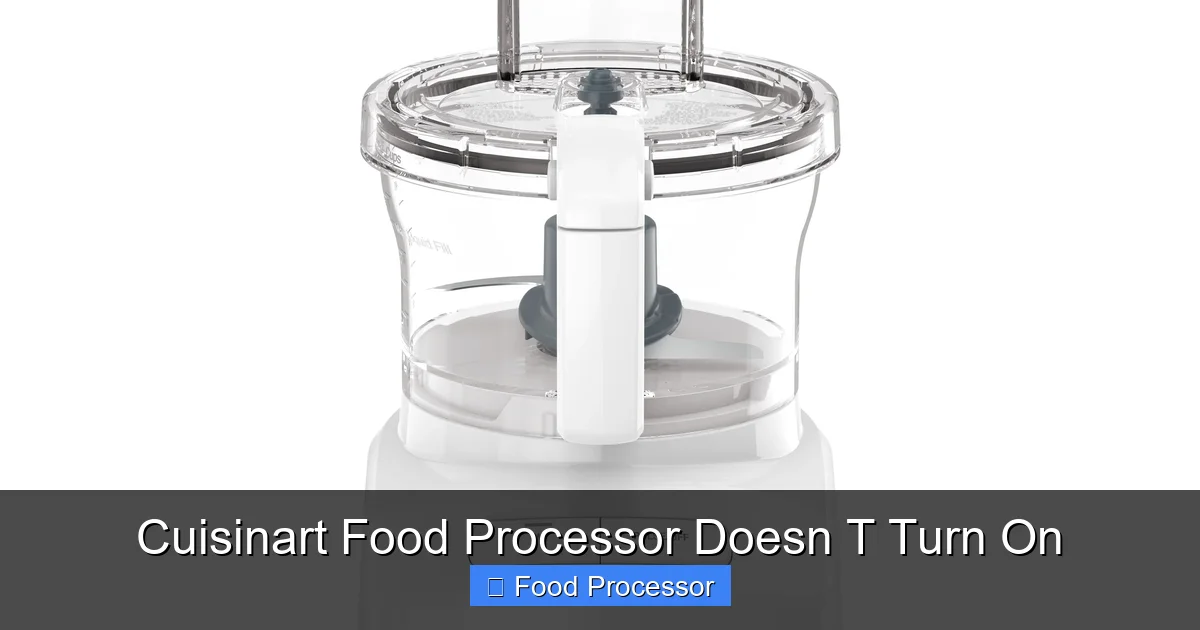
When your Cuisinart food processor doesn’t turn on, it can be incredibly frustrating, but most issues are surprisingly simple to resolve with a bit of troubleshooting. This comprehensive guide provides step-by-step instructions for diagnosing and fixing common problems, covering everything from power supply checks and proper assembly to understanding safety interlocks and resetting overload protection. You’ll learn how to quickly pinpoint why your appliance isn’t starting and implement effective solutions to get your Cuisinart food processor back in action, helping you avoid unnecessary repairs or replacements.
Cuisinart Food Processor Doesn’t Turn On
There’s nothing quite as frustrating as being in the middle of preparing a delicious meal, only for your trusty Cuisinart food processor to suddenly decide it’s not going to cooperate. You plug it in, press the button, and… nothing. No whir, no hum, just silence. A Cuisinart food processor not turning on can halt your cooking plans in an instant, leaving you wondering what went wrong.
The good news is that many instances of a Cuisinart food processor not starting are due to simple, easily fixable issues. You don’t necessarily need to rush out and buy a new one or call a repair technician right away. Often, it’s a matter of checking the power, ensuring proper assembly, or understanding the appliance’s built-in safety features. This comprehensive guide will walk you through a step-by-step troubleshooting process to help you diagnose and fix common problems, getting your kitchen workhorse back to chopping, slicing, and pureeing in no time. If you’re wondering what to do if your food processor won’t turn on, you’ve come to the right place.
Before we dive into the specifics, always remember safety first. Whenever you’re troubleshooting an electrical appliance, make sure it is unplugged from the wall outlet. This prevents any accidental starts or electrical shocks. Let’s get started!
Key Takeaways
- Start with the Power: Always begin troubleshooting by verifying the power outlet, inspecting the cord, and checking your home’s circuit breaker to rule out electrical issues.
- Assembly is Crucial: Cuisinart food processors feature essential safety interlock systems. The appliance will not activate unless the bowl, lid, and pusher are all correctly and securely locked into place.
- Reset Overload Protection: If the food processor was subjected to heavy loads, its internal overload protection might have tripped. Disconnecting it from power and waiting a few minutes often allows it to reset.
- Clear Internal Obstructions: Food debris or other foreign objects lodged around the blade or motor shaft can prevent the motor from engaging. Always inspect and clear these areas carefully.
- Listen to Your Machine: A humming sound without blade movement often indicates a jammed motor or faulty capacitor, while complete silence points to a power or switch issue.
- Consult Your Manual: For specific models, the user manual is an invaluable resource, offering detailed diagrams and model-specific troubleshooting tips.
- Know When to Get Help: If basic troubleshooting doesn’t resolve the issue, or if you suspect an internal electrical problem, it’s best to contact Cuisinart customer service or a qualified technician rather than attempting complex repairs yourself.
1. Verify the Power Source and Cord Integrity
The most common and often overlooked reason a Cuisinart food processor doesn’t turn on is a simple power supply issue. It might sound obvious, but it’s always the first thing to check.
Check the Wall Outlet
Sometimes the problem isn’t with your Cuisinart food processor at all, but with the power outlet it’s plugged into.
- Test with Another Appliance: Plug a different, working appliance (like a lamp or a phone charger) into the same wall outlet. If that appliance also fails to power on, you’ve found your culprit: a dead outlet.
- Try a Different Outlet: If the original outlet is indeed dead, try plugging your food processor into a different, known working outlet in your kitchen or home.
Practical Tip: If you’re using a power strip or extension cord, try plugging the food processor directly into a wall outlet to rule out issues with the strip itself.
Inspect the Power Cord
Over time, power cords can suffer damage from bending, pulling, or accidental cuts. A damaged cord can prevent power from reaching your appliance.
- Look for Visible Damage: Carefully examine the entire length of the power cord for any signs of fraying, cuts, exposed wires, or kinks. Check especially near the plug and where the cord enters the food processor’s base.
- Feel for Heat: While unplugged, feel the cord. If it ever felt unusually warm during use, it could indicate an internal short or damage.
Caution: If you find any damage to the power cord, do not attempt to use the food processor. A damaged cord is a serious safety hazard and should be replaced by a qualified technician or the entire unit serviced/replaced.
Reset the Circuit Breaker
A circuit breaker is a safety device designed to protect electrical circuits from damage caused by an overload or short circuit. If your food processor drew too much power, or if the circuit was already near its limit, the breaker might have tripped.
- Locate Your Breaker Box: This is typically found in a utility closet, basement, or garage.
- Identify the Tripped Breaker: Look for a switch that is in the “off” position, or sometimes halfway between “on” and “off.”
- Reset the Breaker: Flip the tripped breaker completely to the “off” position first, then firmly flip it back to the “on” position.
Important: If the circuit breaker trips repeatedly, there’s a larger electrical issue in your home that needs professional attention. Do not continue to reset it without investigating the cause.
2. Ensure Proper Assembly: The Safety Interlock System
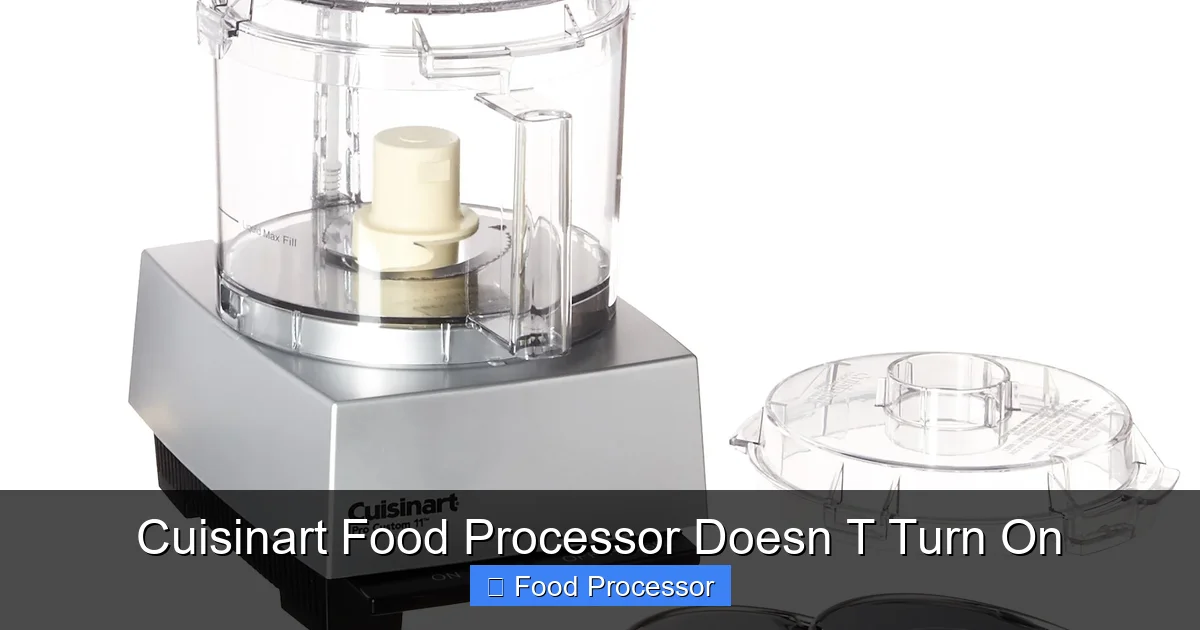
Cuisinart food processors, like many modern kitchen appliances, are equipped with sophisticated safety interlock systems. These systems are designed to prevent the motor from engaging unless all components are correctly and securely assembled. This is a very common reason why your Cuisinart food processor doesn’t turn on.
Visual guide about Cuisinart Food Processor Doesn T Turn On
Image source: m.media-amazon.com
If your Cuisinart food processor is not working, especially after a power check, incorrect assembly is often the next culprit. Think of it like a puzzle – every piece must be in its exact spot for the machine to operate.
The Bowl is Securely Locked
The processing bowl must be correctly seated and locked onto the motor base. Each Cuisinart model has specific locking mechanisms, usually involving aligning arrows or a tab on the bowl with a slot on the base and then twisting until it clicks into place.
- Remove and Re-seat: Take the bowl off the base completely. Carefully place it back on, aligning it precisely, and twist it firmly clockwise until you feel and hear a definite click or until it can no longer turn.
- Check for Obstructions: Ensure there’s no food debris or foreign objects under the bowl that could prevent it from seating properly.
Practical Tip: Don’t force the bowl. If it feels stiff, you might not have it aligned correctly. Lift it and try again.
The Lid is Properly Seated and Locked
After the bowl, the lid is the next crucial component for the safety interlock. The Cuisinart food processor will not activate if the lid isn’t perfectly aligned and locked.
- Align Tabs and Slots: Most lids have tabs that need to align with slots on the bowl. Twist the lid clockwise until it locks firmly. You should hear a distinct click.
- Pusher/Feed Tube Alignment: On many models, the feed tube or the pusher component also needs to be in a specific orientation relative to the handle or a switch on the base for the interlock to engage.
Example: Some Cuisinart models have a safety tab on the lid that needs to depress a switch on the handle of the bowl. If this tab is misaligned or broken, the appliance won’t start.
The Pusher is in Place (For Some Models)
Certain Cuisinart food processor models, particularly older ones or those with advanced safety features, require the pusher (the component used to guide food down the feed tube) to be inserted into the lid before operation can begin. This ensures that hands are kept clear of the blades.
- Insert the Pusher: If your model has this feature, make sure the pusher is fully inserted into the feed tube of the lid.
- Check for Damage: Inspect the pusher for any damage that might prevent it from activating a safety switch within the lid.
Understanding how to assemble a food processor step by step correctly is paramount for Cuisinart models. Any slight misalignment can prevent the safety mechanism from closing the circuit and allowing power to the motor.
Check for Damaged Components
Sometimes, a drop or impact can cause subtle damage to the plastic tabs or locking mechanisms on the bowl or lid. Even a hairline crack or a slightly bent tab can prevent the safety interlocks from engaging.
- Visual Inspection: Carefully examine all plastic components for cracks, chips, or deformities, especially around the locking points.
- Compare to Manual: Refer to your Cuisinart user manual for diagrams of how each part should look and fit.
3. Reset the Overload Protection
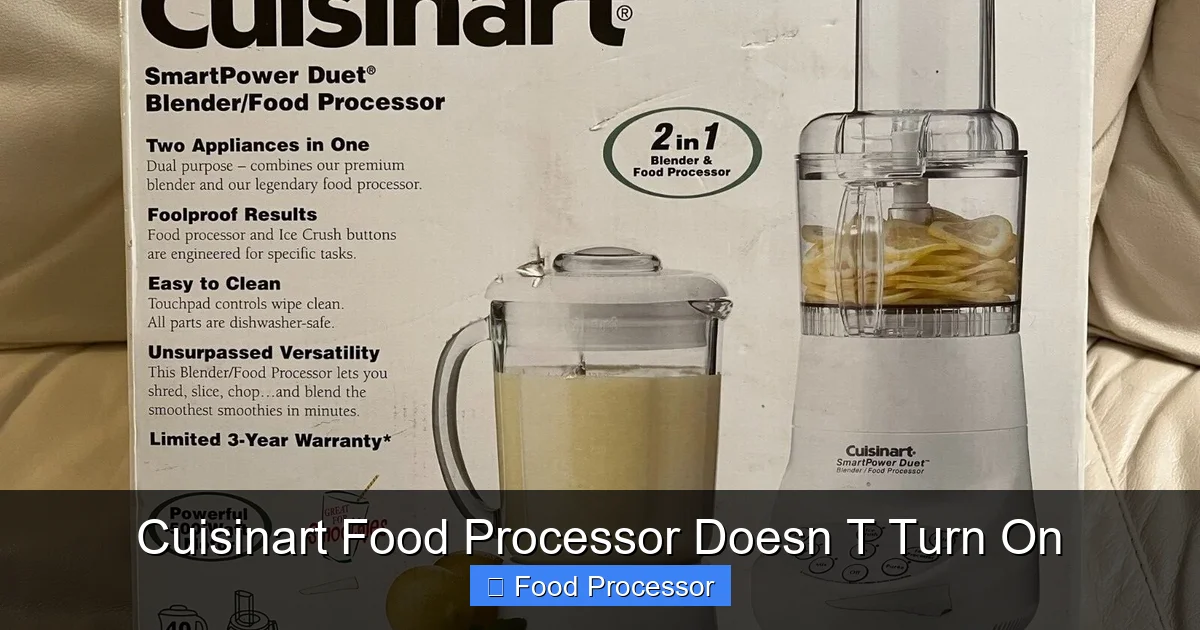
Modern Cuisinart food processors are designed with safety in mind, including an overload protection feature. This system prevents the motor from burning out if it’s subjected to too much strain, like trying to process a very hard ingredient or too large a quantity at once.
Visual guide about Cuisinart Food Processor Doesn T Turn On
Image source: i.ebayimg.com
Understanding Overload Protection
When the motor is overworked, it heats up, and the overload protector acts like a mini circuit breaker, temporarily cutting power to the motor. This is a common reason your Cuisinart food processor doesn’t turn on immediately after heavy use.
How to Reset Your Cuisinart
Resetting the overload protection is usually a straightforward process:
- Unplug the Unit: Disconnect the food processor from the power outlet. This is essential for resetting the internal mechanisms.
- Wait for Cooling: Allow the unit to cool down for at least 5-10 minutes. If the motor was hot, it needs time to dissipate that heat before it can restart.
- Reduce Load: If you were processing a particularly tough or large batch of food, remove some of the contents or cut larger items into smaller pieces to reduce the strain on the motor.
- Plug Back In: After the waiting period, plug the Cuisinart food processor back into the outlet and try to turn it on.
Practical Tip: If the overload protection trips frequently, it might indicate that you’re consistently overfilling the bowl or trying to process ingredients that are too hard for your specific model’s motor strength. Refer to your manual for maximum capacities and suitable ingredients.
4. Clear Any Obstructions Around the Blade or Motor Shaft
Even if the power is on and the assembly is correct, a jammed motor or blade can prevent your Cuisinart food processor from starting.
Remove Bowl and Blade
Carefully disassemble the food processor. Remove the lid, then the blade assembly (being very careful as blades are extremely sharp), and finally the processing bowl.
Inspect the Motor Shaft Area
- Check Under the Blade: Look for any food particles, dough, or other debris that might be wrapped around the blade’s base or stuck in the opening where the blade sits on the motor shaft.
- Examine the Motor Shaft: Inspect the central motor shaft on the base of the unit. Ensure it can spin freely. Sometimes, sticky ingredients can seep down and gum up the shaft.
- Clear Obstructions: Use a small brush, a toothpick, or a damp cloth to carefully remove any visible obstructions. Be gentle and avoid bending any components.
Caution: Always handle the blades with extreme care. Consider wearing cut-resistant gloves if you’re particularly concerned.
5. Listen for Motor Sounds and Check Control Panel
What sounds (or lack thereof) your Cuisinart food processor makes when you try to turn it on can offer valuable clues about the underlying problem.
A Humming Sound But No Movement
If you hear a low hum but the blade doesn’t spin, or the motor doesn’t fully engage, it often points to one of a few issues:
- Jammed Blade/Motor: As discussed above, an obstruction might be preventing the motor from turning. Recheck for any debris.
- Faulty Capacitor: Many motors use a “start capacitor” to give them an initial jolt of power to get moving. If this capacitor fails, the motor might hum but lack the power to spin. This is an internal component and usually requires professional repair.
- Worn Drive Coupling: The drive coupling (the part that connects the motor shaft to the blade) can wear down over time. If it’s stripped, the motor will spin, but the blade won’t. This part is often replaceable.
No Sound at All
Complete silence when you press the “on” button, after checking power and assembly, indicates that no power is reaching the motor or that a key switch isn’t making contact. This could mean:
- Faulty Safety Switch: One of the safety interlock switches (bowl, lid, pusher) might be faulty, even if the components appear correctly assembled.
- Defective Power Switch: The main on/off switch on the control panel might be broken or worn out.
- Internal Wiring Issue: A loose or broken wire inside the unit could be preventing power flow.
Examine the Control Buttons
Take a close look at the control panel. Are the buttons stuck, visibly damaged, or unresponsive? Sometimes, food residue can get underneath buttons, preventing them from making proper contact.
- Clean Buttons: Carefully clean around the buttons with a damp cloth or a cotton swab.
- Feel for Click: Ensure the buttons provide tactile feedback (a clear click) when pressed. If a button feels mushy or unresponsive, it might be faulty.
6. Consider Internal Component Issues
If you’ve gone through all the external checks and your Cuisinart food processor still doesn’t turn on, the issue might lie deeper within the machine’s internal components. At this point, opening the appliance should only be attempted by those with electrical knowledge, or it’s time to call in a professional. This type of failure often points to why how to fix a food processor that is not turning on becomes a bit more complex.
Worn Carbon Brushes (Older Models)
Some older Cuisinart food processors (especially those with universal motors) use carbon brushes to conduct electricity to the motor’s rotor. Over many years of use, these brushes can wear down, leading to intermittent operation or complete failure to start. This is not common in newer, induction motor models but is worth noting for vintage units.
Blown Internal Fuse
Like the overload protector, some food processors have an internal fuse as an additional safety measure. If a significant electrical surge or short occurs, this fuse can blow, cutting power to the motor permanently until replaced. Replacing an internal fuse requires disassembling the unit and should be done by a qualified technician.
Motor Failure
In rare cases, the motor itself can simply fail. This is typically the most expensive repair and often means that replacing the entire Cuisinart food processor might be more cost-effective than repairing it.
7. When to Seek Professional Help or Replace
You’ve tried everything, checked all the common culprits, and your Cuisinart food processor still doesn’t turn on. At this stage, it’s time to consider your options.
- Contact Cuisinart Support: If your appliance is still under warranty, contact Cuisinart customer service immediately. They may offer repair services, replacement parts, or a full unit replacement. Even if it’s out of warranty, they might provide troubleshooting advice or refer you to authorized service centers.
- Professional Repair: For non-warranty issues, a local appliance repair shop might be able to diagnose and fix the problem. Get an estimate first, as the cost of repair can sometimes approach the cost of a new basic food processor.
- Consider Replacement: If the repair cost is high, the appliance is old, or parts are difficult to find, investing in a new Cuisinart food processor might be the most practical solution. Modern food processors often boast improved features, efficiency, and updated safety mechanisms.
Conclusion
It can certainly be frustrating when your Cuisinart food processor doesn’t turn on, especially when you’re relying on it for your culinary adventures. However, by systematically working through the troubleshooting steps outlined in this guide – from checking the power supply and ensuring correct assembly to understanding overload protection and clearing obstructions – you can often pinpoint and fix the problem yourself.
Remember, safety is paramount. Always unplug your appliance before performing any checks or maintenance. If, after all your efforts, your Cuisinart food processor remains unresponsive, don’t hesitate to reach out to Cuisinart customer service or a qualified repair professional. With a bit of patience and methodical checking, you’ll hopefully have your Cuisinart buzzing back to life and tackling your chopping and mixing tasks in no time!
